web page hit counter

Saturday, March 05, 2011

Dallas Big Data Micro Hackathon

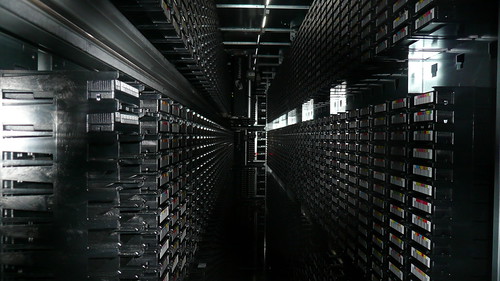
Tape library, CERN, Geneva 2
Tuesday, March 22nd at Cohabitat in Dallas, Texas a group of geeks is getting together to write code to process Big Data. There will likely be a group getting Hadoop up and running on laptops ("Hello, World" level), and possibly a group working with Cassandra and MapReduce on EC2 ("I actually have a real-life problem to solve" level) but anyone who's serious about Big Data is invited. You can sign up at:
"Big Data" isn't a formally defined term, but the general idea is that if your data set could fit on a single disk or be easily hosted inside a normal relational database it's not big data. Google calculating PageRank for every site they index? LinkedIn doing a complete social graph analysis for every user? Those are definitely Big Data problems. Technologies like MapReduce (see Hadoop) and certain kinds of highly scalable NoSQL databases (see Cassandra) fall under the heading, but it's a big tent and there are many other possibilities.
The event is free, but the idea is to keep the group small and focused, so spaces are limited. Sign up at: http://dbdmh.eventbrite.com

Labels: , , , ,

You should follow me on twitter here.

Friday, December 26, 2008

OpenSocial Dev Garage Dallas

=== UPDATE ===

We've got a page on the opensocial.org wiki. This page is the canonical reference for all things OpenSocial Dev Garage Dallas (except the signups, which are still on Upcoming)

If you're developing Facebook apps, it's inevitable that you'll eventually also be developing for the "everybody but Facebook" OpenSocial API. Over the past couple of months, the API has stabilized substantially, and it's probably about time to check it out.

OpenSocial Dev Garage Dallas is your chance to write your first "Hello Friends" application in a supportive group environment. If you're more into writing containers than the gadgets that populate them, we're also planning to have a breakout session on implementing the API so your application can be an OpenSocial gadget host.

The event is planned for Sat, January 17th at the amazing new Cohabitat coworking space in Dallas's historic State-Thomas neighborhood. In the interest of keeping things focused we're capping attendance at 25 people:

http://upcoming.yahoo.com/event/1460416/

If there's enough demand, we may be able to open up some more space, but I'd recommend signing up now if you want to guarantee a spot!

See you there!

Labels: , , ,

You should follow me on twitter here.

Wednesday, June 04, 2008

Some Experiments with the Future of Social Network Technology

I gave a presentation at the recent Dallas Social Network Technology event (yes, we're still trying to come up with a good name. Pictures here.). We ended up with something just over twenty people, but it was exactly the crowd we were hoping for: developers, startup-istas, entrepreneurs and business people actually "doing something" with social network technology. A quick canvas of the attendees indicated that a get-together maybe once a quarter or so, with a meetup for beers slightly more often, might be about right. There was some talk from the general direction of Alamofire about a game-focused event sometime in the fall, and I suspect there will be another general event between now and then.


The presentation was combined with a live demonstration of the Popcitation Facebook application, and both a Google and Facebook login to the Popciation destination site. (All of it, but especially popcitation.com, is a development spike to test out new technology, there's a good chance it won't work quite right for you.) I got about 10% of an OpenSocial version done, I'll try to finish that up in the near future.

Closing thought: it would be cool to have an OpenSocial container with DISO as the backend, huh? Need to do some more research along those lines, for all I know that's the standard assumption...

Labels: , ,

You should follow me on twitter here.

Thursday, December 21, 2006

Web 2.0, Bootstrapping and those Evil VCs

I normally try to avoid jumping on the bandwagon with my blog postings, but I'm making an exception this time because of this post on Web 2.0 and VCs in Fred Wilson's A VC blog. Go ahead and read it now, it's a much more important post than this one...

A little while back I had to do the numbers for a startup business plan. The decision had been made to go for funding, but being an engineer I just had to run the bootstrapping scenario as well. As the post above describes, we had a minuscule burn rate while we were building the product, but after that things got trickier. It came down to a surprisingly risky self-funded growth strategy or an infusion of fairly major cash at about the eighteen month mark.

The slow-growth route turned out to be risky for several reasons[1]: The strategy required us to stay tiny, but that meant depending on just a few customers making up a major percentage of our business. We simply wouldn't be big enough to acquire or support more and we wouldn't have the cash to be hiring. To make the numbers work I had to assume that we got customers fast and kept them forever. Sales and support is shockingly expensive (at least it was to me at that point) If we lost customers we immediately went negative cash flow, which is a very ugly thing when there isn't much left in the bank. And there's that little matter of lag time between hiring salespeople and getting any benefit from them. Just a little bad luck and we were out of business.

Competition was another risk. We knew of several other groups doing similar products. There was much brainstorming on niche strategies (make the slice small enough and you get your own piece of pie), but there are limits. It's hard to eliminate every last competitor without putting yourself in a unsurvivably small niche. You can do it for a while, but if you have any intention at all of growing you have to consider how long it takes to get your product to a larger market. The numbers had to assume we had a magically defensible series of larger and larger markets to play in as we (oh so slowly) grew.

Finally, there was focus. The slow-growth strategy meant an awful lot of "doing this to survive long enough to do this other thing we really want to do." Not necessarily a business risk, but it's a big motivation risk. It can take a very long time to bootstrap your way into a "real" business. Why even do a startup unless you've got a passionate belief in your product idea and want to see it on the market sooner rather than later? Watching the spreadsheet extend out year after year off to the right before we were "there" was sobering.

Of course, VCs are evil and must be avoided at all costs, but to anyone considering bootstrapping all the way up I recommend running the numbers both ways.[2] You might find the devil starts to have a certain appeal when you hit that high growth part of the curve.

The end was, sort of like this post, anticlimactic: things stopped very suddenly and I never found out how accurate my numbers were. Maybe this time around I'll get to see...


[1] All of which will be in any good business book or course on startups. But it's one thing to read it and another thing to live it :-)

[2] The Sloan School OpenCourseWare site is good. Somewhere in there are lectures and notes that mention all of the above points and more, plus pre-filled-in business plans with actual numbers.

Labels:

You should follow me on twitter here.